Street Medicine Comes to Missouri
By Nathanial Nolan, MD, MPH, MPHE
As the U.S. continues to grapple with high rates of housing instability, an increasing number of individuals find themselves homeless. Unsheltered homeless people, those who are sleeping in spaces not deemed suitable for human habitation, constitute a uniquely vulnerable population. This population frequently struggles with severe mental illness and complex substance use disorders, often delaying healthcare until health emergencies arise. In addition to inadequate housing, many will face difficulties with communication (e.g., lack of cell phones, internet, or a mailing address), transportation, and even maintaining social benefits, which often require regular forms/paperwork.
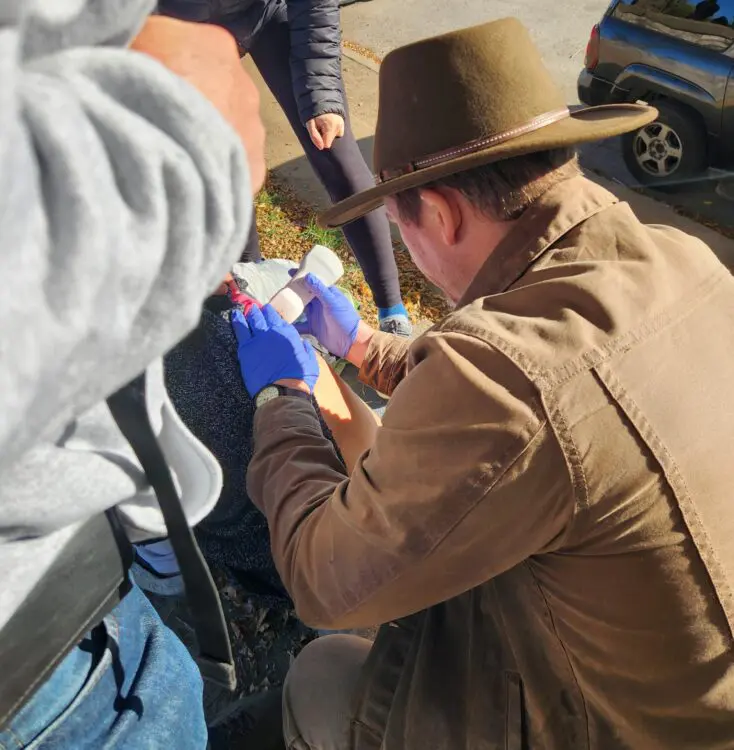
A growing movement in medicine has sought to address some of the barriers to care experienced by those with housing and social instability. Street Medicine, defined as providing medical care in settings such as parks, under bridges, and in tent encampments, is a mechanism for bringing care to those who might otherwise struggle to access it. The Street Medicine Institute sums up the ethos in their slogan, “go to the people.” Street Medicine programs seek to deliver care with the lowest barriers possible, often providing not only medical visits, but medications and supplies at the point-of-service.
Street Medicine has become an increasingly recognized field, with more than 80 programs in the U.S. and 3 fellowship programs. In 2023, CMS created a point-of-service code that can be used in billing for care delivered on the street, and the federal government has been scaling up funding to train doctors to provide this form of outreach care. In Missouri, Freeman Health System and the University of Missouri, Columbia recently received Health Resources and Services Administration (HRSA) funding to establish Street Medicine training pathways for their residents.
My own organization, Street Medicine St. Louis, has experienced growing interest in its services among patients who are otherwise disenfranchised from care. In 2025, we provided longitudinal care, largely delivered tent-side, to more than 400 unique patients. Thus far in 2026, we have cared for more than 550 unique individuals, and we know there are many we have yet to reach. Our experience suggests a growing need, particularly in the state of Missouri, which ranked #4 in the U.S. for the rate of increase in homelessness in 2025.
The services provided are wide-ranging, from urgent and emergent care to long-term primary care. However, at the center of Street Medicine is the relationship. Providing outreach medical care in this fashion requires an incredible amount of trust from patients who often have been treated poorly by the health system. This care is intentionally inefficient, driven by longitudinal relationship-building and letting the patient direct their health goals. However, the outcomes can be transformational and life-saving.
As Missouri increases the breadth and scope of Street Medicine, we are intentionally learning from others. Street Medicine St. Louis recently became an affiliate of USC Street Medicine, one of the largest programs in the U.S. Collaboration is also increasing across Missouri regions as we share best practices. To learn more about Street Medicine in general, I would encourage you to visit the Street Medicine Institute webpage, which offers a wealth of resources and hosts an annual international symposium. Doctors in the St. Louis region would be welcome to connect with Street Medicine St. Louis, a volunteer-based organization that provides services in St. Louis City. In Kansas City, Care Beyond the Boulevard is an organization providing outreach medical care to the housing-unstable, and in Columbia, the Columbia Mobile Aid group provides similar services and supports a wide range of patient needs.
I personally am excited to see this movement grow within our state. The need is great, but I feel Missouri can rise to the challenge. By “going to the people,” I believe we can address health disparities and reach our neediest citizens.