Newsletters
The header image is the default header image for the site.EPIC – Summer 2014
POSTED: June 18th, 2014
POSTED IN: EM Pulse - The Official Newsletter of MOCEP,
|
|

|
From the President
Douglas Char, MD, FACEP
It is summer – hot days, afternoon thunderstorms and steamy nights. Summer is a season of change and transformation. I took over as President of the Missouri College of Emergency Physicians after our General Meeting and elections on April 5th at the MSMA Annual meeting in St Louis. Much thanks to Dr. Larry Slaughter (Columbia) for guiding our organization these past two years. Changes initiated under his watch are now coming to fruition.
Work continues on the website thanks to Dr. Schwarz (St. Louis) and Dr. Heidt (Columbia). Feedback has been positive and traffic is steady. Look for more changes in the coming year as we work to enhance our online presence. We have also started sending out weekly emails. The chapter web site is a wonderful resource – check it out!
Ms. Cecile Landrum has been appointed MoCEP Executive Director effective May 2014. Cecile works out of Gamble & Schlemeier in Jefferson City. She will be devoting a quarter of her time exclusively to MoCEP. A volunteer organization, MoCEP has always relied on its members and the Board of Directors to provide the energy and effort to get things done. We’ve never lacked for ideas but have struggled to find committed time and energy to get projects off the ground and follow through on administrative tasks. In April the Board voted to hire a part-time executive. Cecile met with the MoCEP executive committee this past week. We are setting up monthly Board calls and putting together a master calendar for the coming year (MoCEP fiscal calendar begins each July). Cecile has been learning about ACEP, MoCEP, the role of a Chapter Executive, and what makes Emergency Medicine different from other medical specialties. She brings a wealth of organizational expertise and years of experience to MoCEP. Mr. Jorgen Schlemeier continues as our Governmental Consultant. Ms. Margie Wilson will continue to work with Cecile at G&S to keep MoCEP on track and moving forward. Ms. Landrum can also be reached by e-mail.
I recently returned from the ACEP annual Leadership and Advocacy Conference in Washington, DC May 18-21. Missouri was represented by Board members – Dr. Jonathan Heidt (Columbia), Dr. Evan Schwarz (St Louis), Tim Koboldt (St Louis) and five residents (St. Louis University and Washington University) including the incoming EMRA President, Dr. Matthew Rudy. We visited the offices of all nine House Members and both Senators. My time in Washington really reinforced that it is the connections we make at home in Missouri that matter most. MoCEP will continue to focus much of our energies on Jefferson City. Dr. Larry Slaughter (Columbia) Past President has agreed to lead this effort.
Dr. Jonathan Heidt was elected Vice President and EPIC Editor. It is his goal to keep the membership appraised of what is happening through our quarterly newsletter. If you have news, idea or questions please feel free to drop him an e-mail.
I look forward to getting to know many of you and pledge to work to strengthen MoCEP during my term as President. My four priorities for the next two years include;
- Gaining a better understanding of who MoCEP is – our members and their needs;
- Building alliances with neighboring ACEP state chapters – we are working to develop a regional education conference (Dr. Evan Schwarz is spearheading this effort);
- Creating a more robust administrative infrastructure that is responsive to member needs – appointing an Executive Director was the first step. Appointing chapter committees are next;
- Working with other physician and clinicians who provider Emergency Care in Missouri to help improve the health of our state.
If you have ideas, questions or concerns, please feel free to contact me by e-mail. I want to hear from you!
Letter from Executive Director, Cecile Landrum
Dear MoCEP Members:
I am honored to have the opportunity serve as the Executive Director for the Missouri College of Emergency Physicians and would like to take a few lines to introduce myself.
I was raised in Jefferson City, attended University of Missouri – Columbia for my undergraduate degree, and a few years later completed an MBA from William Woods University in Fulton. 
I started my career as a legislative assistant in the Missouri House of Representatives before transitioning to the executive branch of government. I worked for eight years in motor carrier and railroad regulation under the Department of Economic Development and then moved to the Department of Higher Education where I served as human resource and marketing associate for the student loan guaranty agency.
In 2005 I joined the team at Gamble and Schlemeier, working with clients in education and non-profit fields on advocacy issues and association management.
I look forward to meeting many of you over the next several months and hope you will contact me if I can be of any assistance. I am very excited to work with MoCEP and to help the organization focus on your goals of membership growth, alliance building and advocacy!
Missouri Legislative Session Concludes? For who?
Jorgen Schlemeier
The legislators have gone home for the interim, and the newspapers have all written, “2014 Legislative Session is Over.” As usual, I am confused by what I read in the paper, and therefore am choosing to write my own article about this mystery “end” of session. On May 16th around 6:01 p.m. a large group of people left the Capitol abruptly. I waved goodbye to many, and said “see you on Monday!” Some gave me the universal unhappy gesture and others just laughed at me.
I did not know what to make of it until I got home, had a glass of wine and realized, I bet those puzzled looks and unhappy gestures were from lobbyists who passed all the bills their clients ever wanted in a short 4.52187 months. That is why they thought session was over, because they had nothing left to accomplish. Unfortunately I am just a small town lobbyist who does not generate 100% success for 100% of my clients, therefore my session, and subsequently the MOCEP session, has not concluded.
While there may not be any roll calls taken nor committee hearings scheduled for the rest of the calendar year, my work, nor the work of ED docs, have concluded. In fact this is the most important part of session. The work before the vote.
So, since it is 2014, remembering my 8th grade teacher saying, “if the number is divisible by 2, then it is an even number” – actually as a side note, it is a good thing she did not teach English, because what she should have said was, if the number is EVENLY divisible by 2. I remember some kid in the class noting that every number was divisible by 2, not just the even ones. Technically, he was correct, but he got the honor of making his case to the higher authority, known as the principal, after that comment. Anyway, back to “The work before the vote;” since 2014 is EVENLY divisible by 2, it must be an election year, and in fact it is. Elections require your attention. They only come around every other year – but before we can set our summer “session” agenda, you need some background information on what passed and did not pass during the 2014 legislative session so we know what is left to accomplish.
Medical Malpractice
We attempted to reinstate the caps the Supreme Court found unconstitutional on non-economic damages, but the Trial Attorneys had enough Senators to block a vote. The House passed the bill. We attempted to negotiate with them, but they did not perceive a threat since they could hold up the vote. The lack of progress in the Senate was NOT due to Senate leadership, it is simply a rule that allows a group of Senators to keep legislation from coming to a vote. Clearly this is an issue we need to push this summer and fall before we get back into voting season.
Data – Data – Data is what we will need to push this bill to the next step in the process. I, as well as the members of our coalition, are attempting to collect recent data on med mal premium increases, physicians leaving the state and an increase in litigation. We can gather data for the latter two, but need information from you on the first item. Our Coalition will be meeting in June to coordinate efforts.
Motorcycle Helmet Repeal
The riders are at it again, and want to repeal the liberty infringement law of requiring helmets (their words not mine). The bill did make progress through the House but got hung up in the Senate Transportation Committee, where it eventually died. I testified in opposition on your behalf.
APRN Expansion
The nurses attempted a comprehensive rewrite of the Advanced Practice nurses practice act. The debate centered around whether or not the bill was a dramatic departure from today’s law, or did it simply “update” the law. We took the position that both of their proposals over-reached and certainly created uncertainty with respect to the role of the collaborative practice agreement document. One bill simply repealed all the rules related to collaborative practice arrangements and required the Boards (Healing Arts, Nurses and Pharmacy) to jointly re-file the rules governing the APRN/Physician relationship. That was a non-starter.
The second proposal defined the scope of practice of an APRN, which had some issues, but never really discussed them due to the huge omission of requiring a collaborative agreement. The nurses stated during a committee hearing that their intent was not to eliminate the collaborative agreement, however when we amended their bill to clearly state a collaborative agreement was required, the nurses resisted and did not want to move their bill forward with that language.
Both proposals failed.
Medicaid
Medicaid Expansion, Transformation, Reform-you choose the label, we used it. A bill that had strong support from numerous interest groups, including providers, insurers, recipients, business groups, hospital systems and social welfare organizations could never get any momentum behind expanding the eligibility for Medicaid. The Governor made several attempts to get the legislature to do something on the topic, but the few held up the majority again. Election years are tough years to pass controversial issues, but this measure is tough on any year. Expanding “welfare” is a message the opponents use often, and is well received by many. Each of the last two sessions I have seen a glimmer of momentum for the next session, but it has not materialized to date. Former Governor/Former Senator Kit Bond was pulled from his peaceful retirement of fishing to advocate for the proposal. He certainly motivated his key contacts in the Senate, but unfortunately he could not move the hard opponents.
Prescription Drug Monitoring
Same story as last year, and the year before that – Senator Rob Schaaf has a group of 3 or 4 Senators willing to block the vote on this legislation. As many of you know, he is a physician. He is great to work with on nurse issues and medical malpractice items, but not on this one. The government creep is one step closer to your private life and he believes this is ceding too much independence.
Budget
The Governor is telling everyone who will listen that the legislature overspent and he will have to make cuts by use of the veto pen when he signs the Budget bills. Where will revenues for the state end up; tough to know, other than they are lower than the December prediction. This issue will drive the conversation for most of the summer. The legislature passed a large tax decrease over the objection of the Governor.
- Primary Care Physicians received a nominal increase. The ACA allowed a greater match for states which raised their PCP rates to Medicare rates, however that deal runs out in January, and so the legislature decided not to match Medicare rates for only 6 months.
- House and Senate Budget Chairs appropriated money for a Regional Emergency Department Care Coordination Pilot Project. This project brought forward by Dr. Randy Jotte (he will be the first to note that while he brought it to the attention of the Budget Committee, he gives credit to many for the development of this project) caught the attention of Chairman Rick Stream and became a priority of his during Budget deliberations.
Other Bills Of Interest
Tanning Beds (passed)
After narrowing the scope of the bill dramatically from its original version 2 years ago, the bill passed. It requires annual, written parental consent for minors who use tanning beds.
Texting While Driving (failed)
Expanded the current law prohibiting texting while driving to persons 21 and over. The legislature sees the need for punishing distracted driving behavior, but not willing to give law enforcement another reason to pull over drivers.
Epipen (failed)
Allows other public places like restaurants and amusement parks to stock epipens for public use in emergency situations. A public place would need a physician prescription, similar to the law for school districts passed last year. The bill ran into mild opposition on several fronts and eventually was removed from the legislation
Midwifery Licensure (failed)
Creates an avenue for licensing midwives which would denote credibility to their practices. Not a good bill.
Conscientious Rights (failed)
The effect of this legislation on health care providers and facilities could have been dramatic if passed. The bill created a new cause of action for health care providers against employers (hospitals, pharmacies, etc.) if the employer disciplined a health care worker from refusing to participate in a procedure or task (dispensing certain meds for instance) that violated their conscience. The examples and hypotheticals are endless. The bill did exempt emergency procedures
Reservation of Rights (failed)
Allows an insurance company to establish a separate proceeding to determine if coverage is effective for the insured. Here is the issue: a physician has a med mal suit filed against them. They are fighting the plaintiff, but then may also have to fight with their insurance company to determine whether the physician’s med mal insurance coverage is valid for the claim made in the med mal suit. That would pit the physician against their insurer as well as the plaintiff on two separate fronts.
If you have made it this far, you know can see that “session” for MoCEP is not finished.
Priority Number One! – Get in front of your legislator this summer and fall and talk to them about your emergency department. You do not have to visit with them about specific legislation, but instead educate them on the patients you see, the abuses you encounter, the uninsured versus insured mix, and other statistics that you find of interest. Get to know your legislator. Passing legislation is learned better in your sociology class than your political science class.
Therefore dust off your Human Behavior 101 text book and build a relationship with your legislator which will serve you well and help MoCEP end the “session” because our goals will get accomplished.
2014 ACEP Leadership and Advocacy Conference
Lucy Hormberg, MD, JD
Washington University
Imagine if we could access electronic health records from any ED in the state, look up prior prescriptions for opioids and other controlled substances employ dedicated patient care coordinators for our frequent ED patients, and save $33.65 million? At the ACEP annual Leadership and Advocacy Conference (LAC) this May, I learned that these were the outcomes when the emergency medicine doctors in the state of Washington participated in the advocacy process.
Some of you may be thinking I do not have time to be a part of the political process – in fact; I barely have time to read the rest of this article. Or you may be thinking I do not like politics; I just do not want to be a part of it.
I understand your frustrations. My first experience in advocacy was going to Jefferson City for the MSMA White Coat Lobby Day. I came home frustrated, swearing never to be part of the political process again. It seemed like I had spent all day at the capitol fighting off the implementation of one bad idea after another and any obviously good ideas were not so obvious to my legislators.
So why am I writing about the importance of advocacy?
Because as emergency medicine physicians, we are advocates. We advocate for our patients every day. We see patients, we seek to understand their medical problems in the context of their social environments, and we try to do something for them, including advocating that others – consultants, admitting teams, social workers – help our patients.
Going to LAC helped me re-frame how I thought about advocacy. The advocacy process is more than just the political process. In fact, the political process – how a bill becomes a law – is only one type of advocacy. More common, but less familiar, is the day to day advocacy we do as emergency medicine doctors. Advocacy is speaking up for and doing something about the problems we face as individuals, as physicians, as community members, and as a society.
As emergency medicine docs, we are also in a unique position to advocate for our patients beyond our EDs and hospitals. We are at the intersection of medicine and society; we see the problems our patients face, and the problems of our health care system.
For better or worse, the legislative part is the most prominent part of the advocacy process. It is most prominent because it is often the end of a long process – the implementation of years of work. Implementation, however, means that everyone in the city, the county, the state, or the country is going to be affected. People notice this part of advocacy. To be heard at this end stage, you compete against many interests. Good ideas, bad ideas, and selfish ideas are all interests that a legislator must weigh and sort through. Keep in mind that legislators have their own ideas and interests, too.
If you, like I did, first got involved in advocacy at the legislative stage, you may find yourself fighting implementation of some laws that seem like bad ideas. You may find it frustrating to advocate for bills that seem like good ideas – why would good ideas not be obvious and be streamlined through the system?
At LAC, I learned that I was not going to make ground-breaking changes in my brief, 15-minute visits with my legislators. I learned that we must band together, and join organizations such as MoCEP, because advocacy is best done as a team. But it is through 15-minute visits, over and over again, by one EM doctor after another, that our profession builds relationships with our legislators. These relationships give us the opportunity to discuss the front-line problems and suggest innovative solutions to the issues that we see on a daily basis. As we build relationships with our legislators, we give voice to our profession and to our patients.
The key for our profession to improve the health of our patients is not only excellent medical care but also early and consistent participation in advocacy. Thank you MoCEP members for your continued support.
The History of MoCEP
Evan Schwarz, MD, FACEP
We recently added a new page to the website, the History of MoCEP. We plan for this page to serve as an archive for the history of MoCEP, documenting the achievements of the organization as well as the physicians who have represented Missouri Emergency Physicians either as members of the Board of Directors or College Councilors. Below is a sample of what is on the website. Please feel free to let us know of any other accomplishments that should be placed on the website. Thanks!
Our Timeline
2014 R.R. Hannas Award Winners
The award, entitled the R. R. Hannas, M.D. Emergency Medicine Award, is named after Dr. Hannas, one of the “founding fathers” of Emergency Medicine, who practiced Emergency Medicine in Kansas City on and off for approximately thirty years. Dr. Hannas was chairman of the committee that originally founded the American Board of Emergency Medicine (ABEM). He served on the Board for twelve years and was the fourth president of the organization. He was instrumental in helping to organize the fifth Emergency Medicine program in the country at Northwestern University, and he is also a past president of the American College of Emergency Physicians (ACEP).
The award consists of a certificate suitable for framing and a check. The Medical School Dean, at the recommendation of the Director of Emergency Medicine, selects award winners.
The 2014 R.R. Hannas, M.D., Award Recipients are:
| Seth Bingman | Kansas City Univ. of Medicine & Biosciences (sharing award) |
| Danielle Bishop | Kansas City Univ. of Medicine & Biosciences (sharing award) |
| Kassandra Cooper | A.T. Still Univ. of Health Sciences |
| Kathryn Majors-Foley | St. Louis Univ. School of Medicine |
| Hirak Shah | Univ. of Missouri – Kansas City School of Medicine |
| Stephanie Kae Charshafian | Washington Univ. School of Medicine |
| Allison Zanaboni | Univ. of Missouri – Columbia School of Medicine |
The Battle of the Belt Program…
….Another successful year
Michael Szewczyk, MD, FACEP
The Missouri Battle of the Belt (BOB) program works to reduce motor vehicle injuries and fatalities by educating high school students about the importance of using safety belts. This program was started by the Ozark Chapter of the Emergency Nurses Association. Mary Tuel, RN led the effort and in 2005, working with Barry Spoon, DO, the Missouri College of Emergency Physicians (MoCEP) was awarded a grant by ACEP to expand the program statewide. The program is now part of the Missouri Department of Transportation and includes hundreds of high schools throughout the state. The Missouri Emergency Nurses Association, The Missouri Coalition for Roadway Safety, American Family Insurance and the Missouri College of Emergency Physicians are sponsors.
Each fall participating high schools “battle” each other to win prizes for seat belt use. Here is how the program works. A BOB club is formed at the school. A surprise safety belt survey is conducted of students driving in to the school. This is followed by a 2-5 week school wide educational blitz on the value of wearing a safety belt. During week six, another surprise safety belt survey is done. Based on the results of those surveys, the schools will be recognized if they fall into one the following categories:
- Gold Level: 99-100% usage
- Silver Level: 95-98% usage
- Bronze Level: 91-94% usage
In addition, two schools in each of the seven Missouri regions will receive a cash award for highest percentage and most improved safety belt use. The money is to be used to fund educational activities at the school.
All schools receiving recognition or an award will receive a banner that can be hung in gym. The Missouri College of Emergency Physicians provides funding for the banners and American Family Insurance provides for the cash awards.
The BOB program also sponsors a video Public Service Announcement (PSA) contest. Each year 40 – 80 PSAs are written and produced by high schools throughout the state. A group, that includes representatives from MoCEP, reviews these in December and cash prizes are awarded to the top 3 videos which are then posted on YouTube with links from MODOT and other social media websites. In 2013, the winners were:
- First Place: Washington High School – Stay in the Picture
- Second Place: Pattonville High School – 4 Seconds
- Third Place: Washington High School – Buckle Up Arrive Alive
2013 Battle of Belt Recognized High Schools
NW District
Bucklin High School – Highest Overall & Silver Level
DeKalb High School – Most Improved
Northwestern High School – Bronze Level
North Harrison High School – Bronze Level
NE District
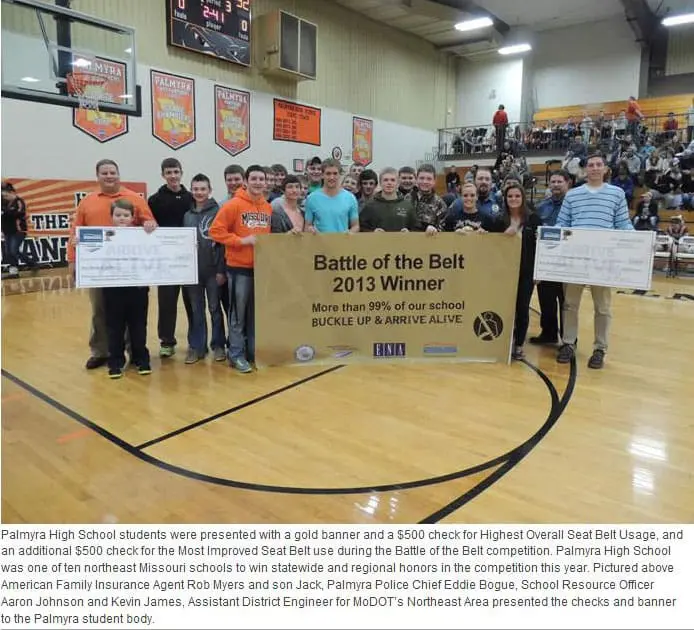
Palmyra High School – Highest Overall & Most Improved & Gold Level
Warrenton High School – Silver Level
Atlanta High School – Silver Level
Highland Jr.-Sr. High School – Silver Level
Clopton High School – Silver Level
South Shelby High School – Bronze Level
Monroe City High School – Bronze Level
Scotland County High School – Bronze Level
Montgomery County High School – Bronze Level
North Shelby High School – Bronze Level
KC District
Belton High School – Highest Overall & Gold Level
Oak Grove High School – Most Improved
Smithville High School – Bronze Level
Park Hill High School – Bronze Level
Kearney High School – Bronze Level
Liberty North High School – Bronze Level
Central District
Eugene High School- Highest Overall & Gold Level
Calvary Lutheran High School- Highest Overall & Gold Level
Bunceton High School – Most Improved
Russellville High School – Silver Level
Morgan County High School – Silver Level
Fatima High School – Bronze Level
Harrisburg High School – Bronze Level
Iberia High School – Bronze Level
St. Elizabeth High School – Bronze Level
Rock Bridge High School – Bronze Level
Tuscumbia High School – Bronze Level
Waynesville Sr. High School – Bronze Level
Osage High School – Bronze Level
St. Louis District
Christian Brothers College High School – Highest Overall & Silver Level
Pattonville Sr. High School – Most Improved
Timberland High School – Silver Level
SW District
Blue Eye High School – Highest Overall & Most Improved & Silver Level
Purdy High School – Bronze Level
Cassville High School – Bronze Level
SE District
Saxony High School – Highest Overall & Silver Level
Clearwater High School – Most Improved
Notre Dame Regional High School – Silver Level
Thomas W. Kelly High School – Silver Level
Mizzou Resident Program
Chris Sampson, MD, FACEP
The University of Missouri-Columbia eagerly awaits the arrival of its first class of residents. We have eight physicians joining us in June, coming from all over the county, some as far away as Seattle and others as close as Columbia. Two of our new residents are graduates of the University of Missouri medical school. We look forward to what will be an exciting three years for them.
SLU Class of 2014
Kene Chukwuanu, MD
The Saint Louis University Emergency Medicine Residency Program would like to congratulate the Class of 2014, its third residency class.
- Kyle Chong MD (The Queen’s Medical Center, Honolulu, HI)
- Kene Chukwuanu, MD (Education Fellowship, St. Louis Univ. Hospital, St. Louis, MO)
- Linh Le, MD (Highline Medical Center, Burien, WA)
- Becky Slater, DO (Westmoreland Emer. Phys. Specialist, Excela Health, Greensburg, PA).
- Eman Spaulding, MD (SSM Depaul Medical Center, St. Louis, MO)
University of Missouri-Kansas City School of Medicine, Truman Medical Center
Christine Sullivan, MD, FACEP
This year marked the 41st year of our program and we feel it continues to be a great place to train with a vast breadth of clinical experience, including critical care and pediatric exposure. This year we expanded our resident evaluation system and continued to incorporate more simulation experiences into the curriculum. We have a Research Director to facilitate scholarly activity in residents and faculty, and will have a new Ultrasound Director as faculty come early fall. We were successful in increasing our resident compliment to 11 residents/year.
Please note that our program will be hosting the Regional SAEM meeting on September 6th, with a welcome reception on September 5th at the National World War I Museum at the Liberty Memorial in Kansas City.
Our graduates for this year and their practice locations are:
- Dr. Beau Butherus-St. Joseph Medical Center, Kansas City, MO
- Dr. Eric Canaday-St. Francis Hospital, Tulsa, OK
- Dr. Erica Carney-EMS Fellowship, Washington University, St. Louis, MO
- Dr. Allen Davied-Providence Medical Center, Kansas City, KS
- Dr. James Hall-Critical Care Fellowship, Washington Univ., St. Louis, MO
- Dr. Thomas Hindsley-Truman Med. Ctr, Univ. of Missouri-Kansas City, Kansas City, MO
- Dr. Stephanie Lewis-Flowers Hospital, Dothan, AL
- Dr. Robert McCullough-Saint Luke’s Hospital, Kansas City, MO
- Dr. Aaron Stinton-Sanford USD Medical Center, Sioux Falls, SD
- Dr. David Tarullo-Wyoming Med. Ctr, Casper, WY
- Dr. Ryan White- Park Plaza Hospital & Houston Methodist, Houston, TX
Washington University Emergency Medicine Residency Class of 2014
Douglas Char, MD, FACEP
- Matthew Dettmer, MD – Critical Care Fellowship; Cooper Univ. Hosp, Camden, NJ
- Lucy Franjic, MD – Faculty; Cleveland Clinic, Cleveland, OH
- Seth Kendler, MD – Médecins Sans Frontières, then Critical Care Fellowship
- Timothy Koboldt, MD – Faculty; Univ. of Missouri, Columbia, MO
- Courtney LeHew, MD – Community; Missouri Baptist Med. Ctr, St. Louis, MO
- Derrick Lowery, MD – Palliative Care Fellowship; Emory Univ., Atlanta, GA
- Jesse Mecham, MD – Critical Care Fellowship; Washington Univ., St. Louis, MO
- Eva Moses, MD – Community; Holy Cross Hospital, Silver Spring, MD
- Kristen Mueller, MD – Faculty; Washington Univ., St Louis, MO
- Candace Nall, MD – Community; St. Elizabeth’s Hospital, Belleville, IL
- Joan Noelker, MD – Faculty; Washington Univ., St. Louis, MO
- Matthew Rudy, MD – Community; Univ. Hospital, Augusta, GA
Clinical News
Hypertonic Saline Indications for Bronchiolitis Lack Evidence for Clear Guidance
The therapeutic value of hypertonic saline in treating bronchiolitis in young children remains unclear, based on the findings of two randomized controlled trials with conflicting results.
Read the entire article
Statins Don’t Help, May Harm in COPD, Sepsis-Associated ARDS
Two separate prospective, multicenter trials of statins stopped early when interim results showed they did not help – and potentially harmed – patients with moderate to severe chronic obstructive pulmonary disease or sepsis-associated acute respiratory distress syndrome.
Read the entire article
Telemedicine Gives Small Hospitals the Biggest Boost in rTPA Use for Stroke
A telemedicine program for patients with acute ischemic stroke increased the use of recombinant tissue plasminogen activator by as much as 13% in the year after implementation.
Read the entire article
213 E. Capitol #200
Jefferson City, MO 65101
Copyright © 2010 Missouri Chapter American College of Emergency Physicians. All rights reserved.Unsubscribe