Newsletters
The header image is the default header image for the site.Never Too Early to Beginning Advocating for Our Patients
POSTED: June 18th, 2018
POSTED IN: EM Pulse - The Official Newsletter of MOCEP, May/June 2018,
Written by: Sahar Morkos El Hayek, MD. Chief Resident, Washington University in Saint Louis
A.L., 28-year-old female, presented to the ED after an overdose on heroin. She received Naloxone and was discharged home, awake, alert, and oriented. A.L. was brought back to the ED two days later, again after a heroin overdose, but that time, it was already too late… A.L. was my first overdose patient when I was an intern.

 Being an Emergency physician means far more than having the knowledge and skills to provide emergent medical care to patients in acute distress. To millions of people, emergency physicians are the safety net; we are their primary source of medical care, possibly even their only one. Our ability to provide the best patient care and fulfil our duty towards our profession and the communities we serve, are affected by socio-economic and legislative status. Over the last few years, ED visits for opioid use disorders as well as deaths from overdose have reached unprecedented levels, taking their toll on families, society, hospital resources, and healthcare in general. ED physicians are at the frontline of this epidemic. Over the last few months, however, emergency departments across the country have been encountering shortages in essential drugs used in the acute setting, including IV fluids, anti-emetics, as well as alternatives to opioids for pain management. Those shortages constrained our ability to provide optimal, safe, and efficient care to our patients on a daily basis without having to resort to second-line agents. This means delays in care, questionable safety profiles, and simply, suboptimal care. Emergency departments were again at the frontline in facing the numerous natural disasters and mass casualty incidents, which despite the external sources of aid, proved to us that disaster readiness is far from perfect and should be a top priority. For those reasons, and many others, LAC came to be, and is the conference where solutions are sought.
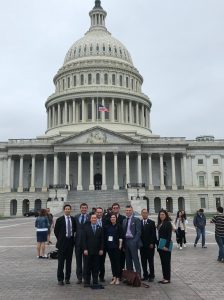
ACEP’s annual Leadership and Advocacy Conference is a unique opportunity for physicians who are eager and willing to speak up for our profession, our practice, and most importantly our patients. The opioid epidemic, drug shortages, and disaster preparedness were all on the agenda for this year. Emergency Physicians from centers across the nation met in D.C. on May 20th to voice those concerns, to present facts about the real, daily impact of those problems on our communities, and to ask our Legislators for support in finding solutions moving forward.
Being a first time attendee, I was amazed at the passion and enthusiasm portrayed by leaders in emergency medicine and the dedication to one goal: meet at Capitol Hill as one unified front to advocate for solutions to the mentioned points. Our asks were to support ALTO (Alternatives to Opioids) and MAT (Medication Assisted Treatment) programs, so that patients like A.L. can receive a warm handoff that bridges their ED visit into their outpatient follow-up. We also voiced concerns about drug shortages and stressed the need to ask the FDA to convene the Drug Shortages Task Force and address the causes leading to them. On a personal level, this conference was an opportunity for me to meet our legislators as well as great names in emergency medicine, to learn from their stories, and to witness how and where change happens. It was an inspiring experience for me as young participant, an incentive to get more involved in advocacy and leadership to better fulfil my duty as Emergency physician.
To all young physicians like me: LAC is a great conference; it’s never too early to attend in your career, and it’s definitely never too early to start advocating for our patients. So why not do it through streamlined efforts with others who share your interests, concerns, and aspirations for better Emergency care?