Newsletters
The header image is the default header image for the site.Bio-Surveillance and the Opioid Epidemic
POSTED: December 3rd, 2024
POSTED IN: 2024 Quarter 4, EM Pulse - The Official Newsletter of MOCEP,
by Shawn Billings, Missouri Hospital Association
Often compared to the loss of life we’d see with a Boeing 737 crash each day, the overdose epidemic takes nearly 300 lives every 24 hours in the United States. This astounding statistic holds despite optimistic reports of decreases in overdose deaths in 2023 and 2024. To combat this epidemic, the CDC has funded Missouri, and 19 other states, to engage in bio-surveillance initiatives. The Missouri Hospital Association, in collaboration with the Missouri Department of Health and Senior Services as well as the Missouri State Public Health Laboratory (MSPHL), are working together with pilot hospitals to better understand the substances impacting our community members.
Through the bio-surveillance initiative, pilot emergency departments are freezing deidentified, residual blood plasma taken from suspected nonfatal overdose patients during typical triage procedures. This plasma is then shipped to the MSPHL and analyzed for Fentanyl and 22 of its most common analogues. This initial testing panel stems from a spike in the manufacturing of opioids with a slightly different chemical make-up from Fentanyl to avoid detection. As the overdose epidemic moves into the fourth wave, a boom in deaths involving polysubstance use, the CDC is shifting their focus to a wider array of substances. In early 2025, Missouri will follow suit and see an expanded panel covering not only Fentanyl and several related opioids but also benzodiazepines, stimulants, and xylazine.
Through the drug overdose bio-surveillance initiative, the CDC hopes to better inform prevention and treatment work nationwide. In Missouri, this data will be used to better understand regional and statewide trends and emerging threats. Through active collaboration with pilot hospitals, community programs, and coalitions, this overdose data will contribute to rippling action.
SUD/OUD
Emergency departments (ED) across the United States are part of the health care safety net and serves as the point of primary care for millions of Americans. Considering the high prevalence of unmet needs of substance misuse and substance use disorder (SUDs) among ED patients, ED practitioners serving on the frontlines are uniquely positioned to intervene. Screening, brief intervention, and referral to treatment (SBIRT) is a public health approach to the delivery of early intervention and treatment services for individuals at risk of developing substance use disorders and those who have already developed these disorders. SBIRT can be flexibly applied and delivered in many clinical care settings.
The SBIRT model represents a paradigm shift in substance use and misuse interventions. Traditionally, interventions have focused on individuals who have severe substance use or those who meet the criteria for substance misuse or dependence as defined by the Diagnostic and Statistical Manual of Mental Disorders (DSM-V). The SBIRT model provides for services on a full continuum of substance involvement. In addition to providing for specialty SUD treatment, SBIRT also targets people who do not yet meet criteria for an SUD and provides effective strategies for early intervention before the need develops for more extensive or specialized treatment.
SBIRT shows promise in many medical settings in facilitating early identification of risky substance use. Screening large numbers presents a greater opportunity to engage those individuals in need of treatment and recovery services. SBIRT can also be used as an opportunity to teach medical staff about substance use disorders and evidence-based treatments, including pharmacotherapies that can be implemented in primary care.
EPICC
Funded through the Missouri Department of Mental Health (DMH), EPICC provides 24/7 referral and linkage services via certified peer specialists (CPS) who respond to Emergency Departments (ED), Emergency Medical Services (EMS) and community-based organizations to assist community members experiencing an overdose and/or substance use crisis. Assistance is provided by a CPS for those referred by establishing immediate linkages to recovery supports and evidence-based substance use treatment e.g., FDA-approved medications to treat opioid use disorder. The goals are to engage community members experiencing an overdose and/or substance use crisis and include the following:
- Addressing social determinants of health e.g., housing, food, transportation, and other barriers to treatment.
- Integrating harm reduction practices into programming e.g., providing individuals overdose education, naloxone, and fentanyl test strips.
- Connecting individuals to Recovery Community Centers to establish pro-social outlets.
- Linking individuals to evidence-based substance use treatments e.g., FDA-approved medications to treat opioid use disorder (MOUD).
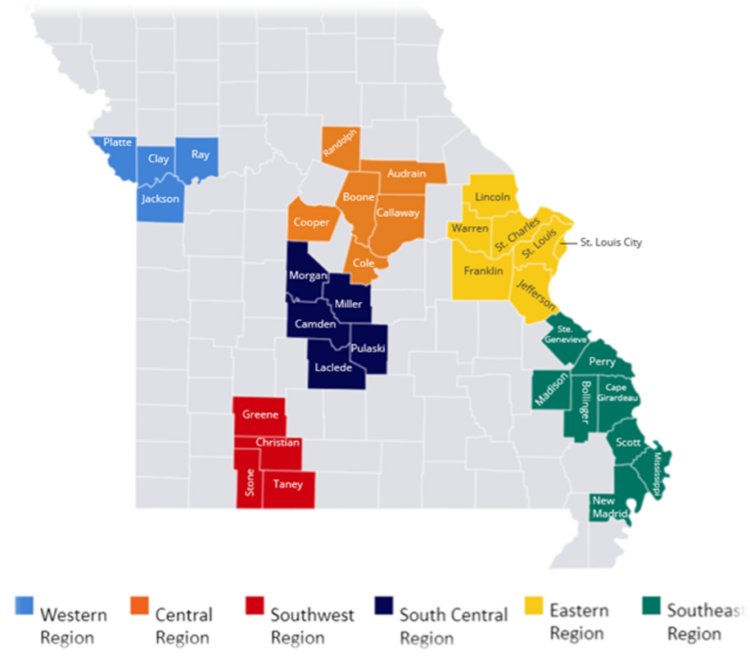
EPICC was initially launched by the Behavioral Health Network of Greater St. Louis (BHN) in December 2016. In 2018, the Missouri Hospital Association partnered with BHN and DMH to replicate the EPICC model in select regions of the state. The initial expansion of EPICC occurred in 2019 with three programs launching in the central, southwest and western regions. The program continues to demonstrate promising outcomes and was again expanded in FY24 to provide EPICC programming in the southeast region and in FY25 to enhance programming in the central, southwest and western regions by increasing CPS staffing levels. EPICC programming is currently offered in the central, eastern, western, southwestern, southeastern, and south-central regions of Missouri. In terms of reach, EPICC staff have responded to over 26,000 referrals and counting.